What is AI Memory? A Complete 2026 Explainer
AI memory gives an AI persistent context across conversations. ChatGPT, Claude, and Gemini all shipped it in 2026, and how each works varies by provider.
What is AI Memory? A Complete 2026 Explainer
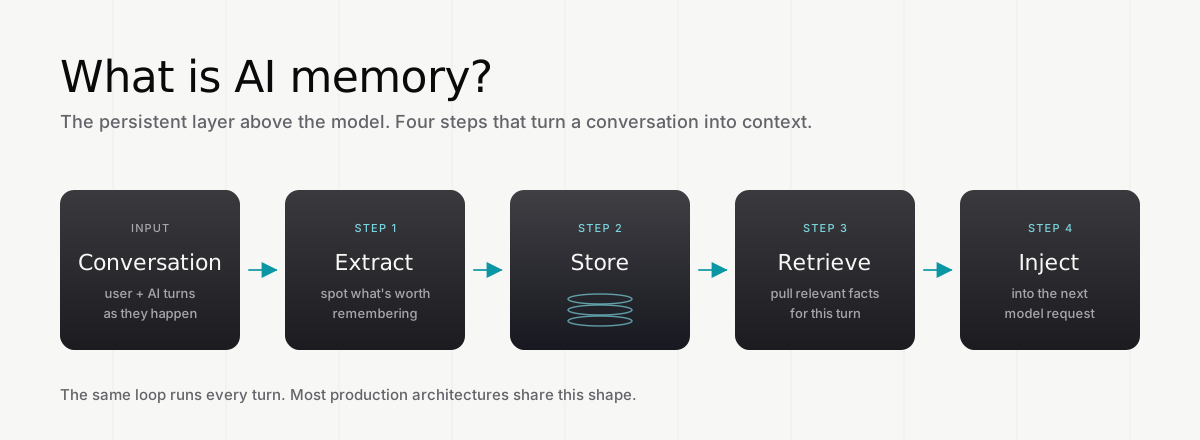
AI memory is not the model. It's the layer above it that survives the next request, the part that lets an AI remember what you said last week, last month, or last year. The model itself is stateless. Every API call starts fresh.
Until 2025, most consumer AIs didn't have memory at all. Then OpenAI shipped it,1 Anthropic followed in September 2025 and opened it to all users by March 2026,2 and Google rolled Gemini's Personal Intelligence out across markets the same quarter.3 Each provider's design is different. The marketing makes them sound identical. They aren't.
Key Takeaways
- AI memory is an external system that stores information from past conversations and injects relevant pieces back into future ones. It's separate from the model and from the context window.
- Long-term AI memory has three parts: episodic (specific events), semantic (general facts), and procedural (learned patterns).4
- Every major AI provider shipped consumer memory between February 2024 and March 2026.12
What is AI memory, exactly?
AI memory is the ability of a language model or agent to retain information across separate sessions. The model itself can't do this. Memory layers emerged as a direct response to LLM statelessness: every inference call resets, and the industry built external stores that extract information from sessions, persist it, and inject relevant pieces into future context windows.5
The simplest mental model: the LLM is the brain, the context window is short-term focus, and memory is the notebook the brain writes to and reads from between sessions. Without memory, every conversation starts at zero. With memory, the system can answer a question about last Tuesday's work without you having to repeat it.
A useful framing comes from the field of agent engineering. AI memory is one piece of context engineering, the broader discipline of curating everything a model sees beyond the prompt itself. The other pieces are the system prompt, tool definitions, retrieved documents (RAG), few-shot examples, and the output schema. Memory's job inside that stack is the persistence slot: the part that survives the conversation ending.
This separates AI memory from two adjacent concepts that get confused with it. It is not the context window. It is not retrieval-augmented generation (RAG). Both share machinery with memory, but neither is the same thing.
How AI memory differs from a context window
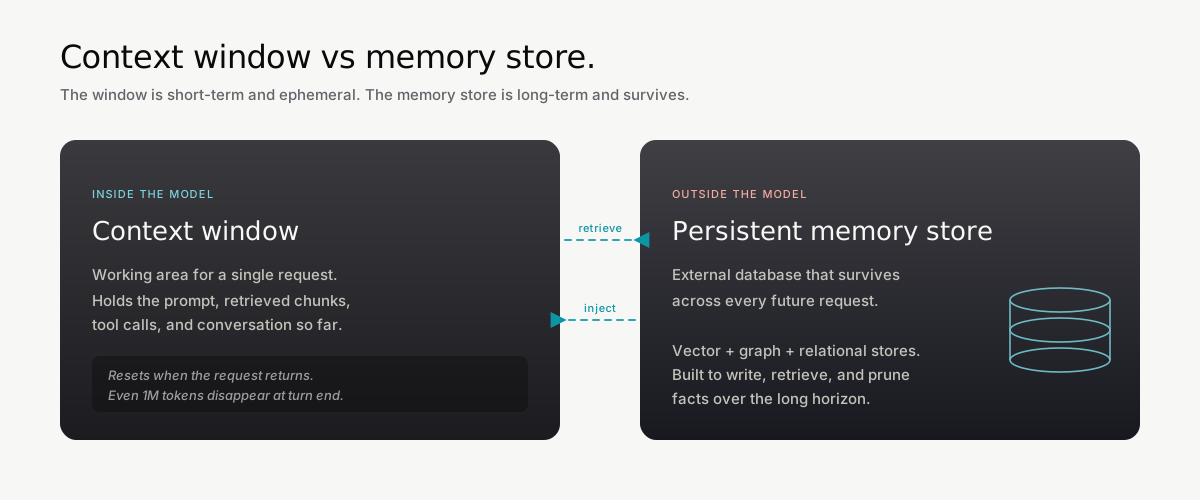
The context window is the model's working area for a single turn. In 2026 those windows are large. Claude Sonnet 4.6 ships with 1M tokens at standard pricing,6 GPT-4.1 reaches 1M, Gemini 2.5 Pro and Gemini 3 Pro reach up to 10M for some workloads.7 None of that survives the request. Once the model returns a response, the window resets.
Memory is the layer that persists. It lives in an external database, not inside the model. When a new request comes in, the memory layer queries for relevant prior context and injects it into the context window before the model runs. The context window is short-term and ephemeral. The memory layer is long-term and survives.
There's also a quality reason memory exists separately from a stuff-everything-in approach. Research has consistently shown that LLM accuracy drops 10-20 percentage points when relevant information sits in the middle of a long context rather than at the beginning or end.7 Anthropic named the broader pattern context rot: as token count grows, the model's ability to accurately use what's inside the window degrades.8 Memory fixes this by retrieving only the few facts that matter for this turn, instead of dumping the entire history into the window.
The types of AI memory
Modern AI systems use four kinds of memory in combination.4
Working memory is the immediate context the model is reasoning over. It lives inside the context window and disappears when the turn ends. Every model has this by default.
Episodic memory captures specific events, time-stamped and tied to particular interactions. The system might log that on Tuesday you asked it to summarize the Q3 financial report and what the summary said. Episodic memory is how an AI recalls what you were working on yesterday.
Semantic memory holds general facts about you, the project, or the domain. Examples:
- You're a vegetarian.
- Your company is a B2B SaaS startup serving healthcare providers.
- The codebase uses TypeScript and Postgres.
Semantic memories are timeless. They remain true across conversations and don't need a date attached.
Procedural memory holds learned patterns:
- You prefer short answers in plain prose, not bullet lists.
- When asked for code, you want explanations after the snippet, not before.
Procedural memories shape how the AI responds, not what facts it has.
A well-designed AI memory system uses all four, with retrieval logic that pulls from each based on what the current turn needs. Some systems blend them into a single store. Others keep them physically separate. Production memory architectures often unify extract-and-consolidate logic across all four types in a single pipeline.
How AI memory works in 2026
The architecture across most production systems follows the same four-step pipeline.
Extract. As a conversation happens, an extraction process scans for facts worth remembering. This can be a rules-based filter, a smaller LLM running in the background, or the same model deciding what to save. Extraction quality decides what the memory layer is even capable of recalling.
Store. Extracted facts get written to a database. Most systems use a vector database for semantic search (Pinecone, Weaviate, Qdrant, pgvector), sometimes paired with a graph database for relationships, and a relational store for structured facts. Production architectures typically go hybrid: vector store for fuzzy retrieval, graph store for entity relationships.
Retrieve. When a new request arrives, the memory layer queries for relevant facts. The query usually combines semantic similarity, keyword match, recency, and importance. Production systems like Letta run multiple retrieval strategies in parallel and merge the results.9
Inject. Selected facts get formatted and placed into the context window before the model runs, usually as a system message section. The model then has access to everything it needs without you having to repeat it.
The full loop runs every turn. Quality is measured by benchmarks like LoCoMo, which evaluates very long-term conversational recall across 300-turn dialogues and up to 35 sessions per user,10 and LongMemEval. Purpose-built memory pipelines benchmark above 90 on LoCoMo and save the bulk of the token cost of stuffing everything into the context window.
The gap between memory architectures is wider than the gap between models. On LoCoMo, the same underlying LLM scores significantly higher when paired with a purpose-built memory layer compared to a built-in one. The model didn't change. The memory pipeline did. That gap is where most of the work in 2026 is happening.
AI memory in major tools right now (May 2026)
Each major provider now offers some form of consumer memory. The architectures and the user experience vary.
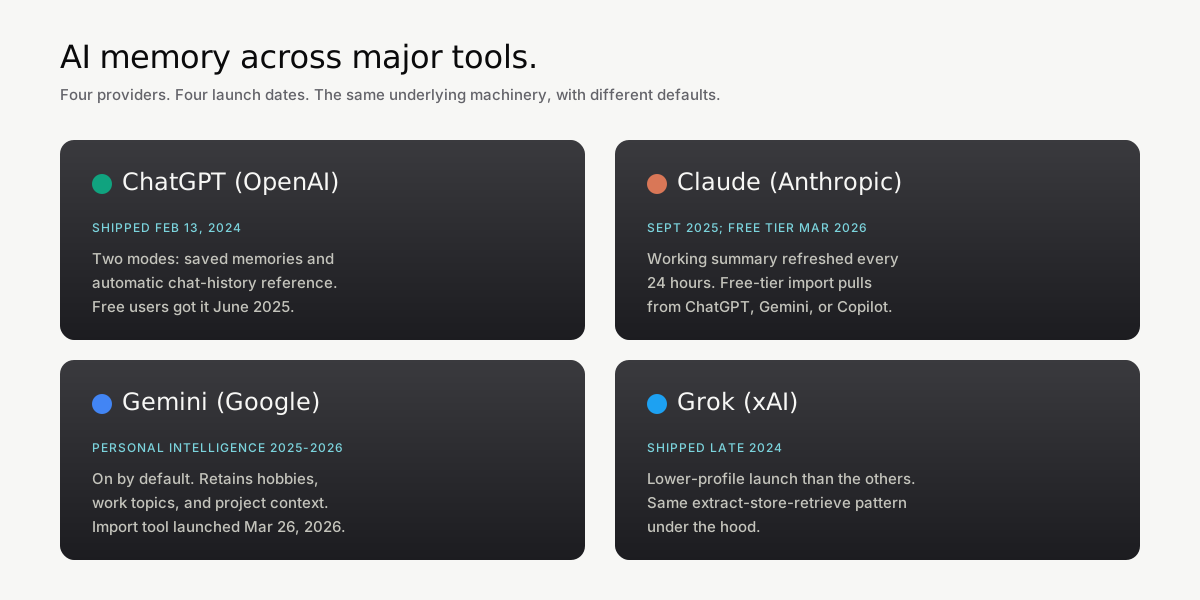
ChatGPT (OpenAI). Memory launched February 13, 2024 as an opt-in test, then went broadly available across Free, Plus, Team, and Enterprise on September 5, 2024.1 On April 10, 2025, OpenAI added an automatic chat-history reference layer that pulls context from past conversations without you having to mark anything to save.11 Free users got a lightweight version on June 3, 2025, providing short-term continuity across recent chats. The memory operates in two modes: Saved Memories you ask for explicitly, and chat-history insights gathered automatically.
Claude (Anthropic). Anthropic launched Claude memory on September 11, 2025 for Team and Enterprise, rolled it out to Pro and Max on October 23, 2025, and opened it to free users on March 2, 2026 with a one-shot import flow at claude.com/import-memory that pulls a profile from ChatGPT, Gemini, or Copilot into Claude.2 Claude scans chat history and synthesizes a working summary, refreshed roughly every 24 hours. On April 23, 2026, Anthropic added persistent memory for Claude Managed Agents in public beta, with memories stored as filesystem files developers can export and edit.12
Gemini (Google). Google's Personal Intelligence rolled out across markets through 2025 and 2026. Memory is on by default. The system retains hobbies, work topics, project context, and names. On March 26, 2026, Google launched its own import tool that pulls a profile from a competing AI into Gemini.3
Grok (xAI). Grok added memory in late 2024 with a similar opt-in model. Lower profile than the others, but the architecture follows the same extract-store-retrieve pattern.
The product names differ. The underlying machinery is convergent. What separates them in practice is not the algorithm, it's the choices each provider makes about what to remember by default, how aggressively to consolidate, how visible the memory is to the user, and whether memory ever leaves the provider's servers.
Cross-LLM memory: keeping context portable
Every memory system covered above is locked to one provider. ChatGPT memory stays in ChatGPT. Claude memory stays in Claude. Gemini's stays in Gemini. The moment you switch tools, the AI you opened doesn't know what the AI you closed knew.
Cross-LLM memory is the workaround: a single store that sits above multiple providers and feeds each one the same context.14 It's an external layer, not a built-in feature, and a small category of tools emerged in 2024-2026 to do exactly this.
Tools that act as a cross-platform AI memory layer
These four tools each take a different angle on the same problem. The category is small and the trade-offs are real, so naming them honestly is more useful than a feature dump.
MemoryBase is a cross-platform AI memory layer that syncs conversations across ChatGPT, Claude, and Claude Code into a single store organized by project and topic, with more tool integrations rolling out. Context Packs let you choose what loads into each session.
Letta (formerly MemGPT) is a stateful-agent framework with persistent memory as a core primitive. It's research-rooted, dev-focused, and aimed at people building agent infrastructure rather than consumer chrome extensions.
Supermemory focuses on the embedding and RAG layer of memory rather than the consumer-facing sync. Targets ML and RAG developers building memory infrastructure.
MemoryPlugin offers a ChatGPT-and-Gemini-focused memory extension that targets the consumer pain queries (memory full, context window limits) directly. Smaller domain authority than the others.
The trade-off across all of them is the usual one for an extension layer. You add a piece to your stack. You gain portability across whichever AI you're using.
Persistent AI memory: what that actually means
Persistent is the qualifier that separates short-lived memory from the kind that survives across every future session. Most consumer AI memory in 2026 is persistent by default. The provider stores your memories on their servers and they remain available indefinitely until you delete them.
Persistent memory has three operational requirements. The store has to write a new fact, retrieve relevant facts at query time, and decide what to drop or compact when the store grows. Naive systems just keep adding. Better systems consolidate and prune.
Anthropic's Auto Dream feature for Claude Code is one example: between sessions, the agent compacts memory files, merges duplicates, and resolves contradictions. The pattern is becoming standard. A memory store that grows monotonically eventually becomes unusable noise.
Where AI memory falls short
The technology works. It also breaks in predictable ways. The honest assessment of memory in 2026:
Memory rot. As the store grows, retrieval gets noisier. Old facts compete with new ones. Production systems use compaction, summarization, and importance scoring to fight this, and even the best ones still degrade over very long horizons.
Stale facts. A memory that's no longer true, like recording a city the user moved away from, is worse than no memory. Most systems don't yet handle invalidation well.
Hallucinated retrieval. Vector search retrieves semantically similar context that might be wrong for the current turn. The model then treats the retrieved text as authoritative.
Provider lock-in. Each major AI's memory lives on that provider's servers and can't be moved natively. Anthropic's one-shot import is a workaround, not a sync. The OpenAI side of the equation has no equivalent export beyond manual paste.
Privacy. Memories accumulate personal details indefinitely. Most providers offer memory-off toggles and deletion controls, but the default is on.
Hallucinated facts. Some systems write memories that the user never actually said, inferred from the conversation in a way the user didn't intend. Strong importance scoring and user-visible memory edit logs help, but the failure mode is real.
For the practical angle on each major tool, see how to make ChatGPT remember across conversations and how to share context between ChatGPT and Claude. For the underlying problem in plain language, see stop repeating context to AI.
Frequently asked questions
Is AI memory the same as a long context window?
No. The context window is short-term and lives inside the model for a single request. Memory is long-term and lives in an external store between requests. Even a 1M-token context window resets when the request ends. Memory is what survives.13
How does AI memory work in ChatGPT specifically?
ChatGPT has two memory modes. Saved Memories are details you ask it to remember explicitly. Reference Chat History pulls automatic context from past conversations.14 Both are optional. Both can be turned off in settings.
Does Claude have memory?
Yes. Anthropic launched Claude memory on September 11, 2025 for Team and Enterprise, expanded it to Pro and Max on October 23, 2025, and opened it to free users on March 2, 2026 with a one-shot import that copies a memory profile from ChatGPT, Gemini, or Copilot into Claude.2 Claude scans chat history and builds a working summary that refreshes every 24 hours.
Can AI memory be turned off?
In every major consumer AI: yes. ChatGPT, Claude, and Gemini all expose toggles to disable memory or delete specific entries. The defaults differ across providers. Gemini and Claude are on by default. ChatGPT memory is on by default for paid users and was rolled out gradually to free users.14
Can I move my AI memory from one provider to another?
Partially. Anthropic shipped a one-shot import on March 2, 2026 that copies a memory profile from ChatGPT, Gemini, or Copilot into Claude.2 Google launched its own import for Gemini on March 26, 2026. OpenAI doesn't offer an equivalent export beyond manual copy-paste. For continuous cross-tool memory rather than a one-time transfer, the cross-LLM memory category covered above is the practical option.
Sources
- OpenAI, Memory and new controls for ChatGPT. Retrieved 2026-05-08.
- Anthropic, Claude memory rollout (September 2025 launch, March 2026 free-tier import). Retrieved 2026-05-12.
- MacRumors (March 26, 2026), Google Launches Gemini Import Tool. Retrieved 2026-05-12.
- MachineLearningMastery, Beyond Short-term Memory: The 3 Types of Long-term Memory AI Agents Need. Retrieved 2026-05-08.
- Atlan, Memory Layer vs Context Window: What's the Difference?. Retrieved 2026-05-08.
- Anthropic, Context windows (Claude API documentation). Retrieved 2026-05-08.
- Elvex (Q1 2026), Context Length Comparison: Leading AI Models in 2026.
- Anthropic Engineering (September 29, 2025), Effective context engineering for AI agents.
- Letta, Agent Memory: How to Build Agents that Learn and Remember. Retrieved 2026-05-08.
- Snap Research, LoCoMo: Evaluating Very Long-Term Conversational Memory of LLM Agents. Retrieved 2026-05-08.
- TechCrunch (April 10, 2025), OpenAI updates ChatGPT to reference your past chats.
- EdTech Innovation Hub (April 23, 2026), Anthropic adds persistent memory to Claude Managed Agents in public beta.
- Redis, RAG vs Large Context Window: Real Trade-offs for AI Apps. Retrieved 2026-05-08.
- OpenAI Help Center, Memory FAQ. Retrieved 2026-05-08.